Pitru Paksha: The Sacred Duty of Remembering Our Ancestors
Exploring Shraddha, Tarpan, Pitru Rina, Mahalaya Amavasya and the timeless ancestral wisdom of Sanatana Dharma.
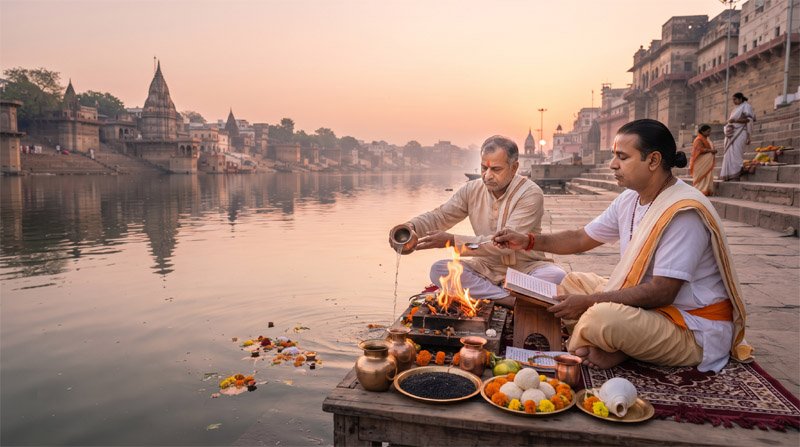
Introduction: When Remembrance Becomes Dharma
There are moments in the Hindu understanding of life when the boundary between remembrance and worship becomes beautifully subtle. Pitru Paksha is one such sacred period.
Known as the fortnight dedicated to the Pitṛs — the departed ancestors of one’s lineage — this period turns the mind away from personal achievement and toward gratitude, continuity, responsibility and remembrance.
The Sanskrit word Pitṛ refers to the forefathers or ancestral beings, while Śrāddha is the ancestral rite performed with faith and reverence. In the broader dharmic vision, the individual is never regarded as an isolated being.
One is born into a lineage, receives nourishment, knowledge, culture and life through previous generations, and therefore carries obligations toward those who came before.
This is reflected in the ancient idea of Pitṛ-ṛṇa — the debt owed to one’s ancestors.
Pitru Paksha is not merely a season of mourning. It is dharma expressed through remembrance.
What Does Shraddha Actually Mean?
The word Śrāddha is traditionally connected with śraddhā — श्रद्धा, faith, reverence and heartfelt trust.
Traditional Definition
श्रद्धया दीयते यस्मात् श्राद्धं तेन निगद्यते ।
That which is offered with śraddhā — with faith, reverence and sincerity — is traditionally called Śrāddha.
This is important because Śrāddha is not simply about food. It is about the consciousness with which the offering is made.
A person may give something materially valuable, yet the deeper question of Śrāddha is whether the act arises from reverence, remembrance and dharmic responsibility.
Bhagavad Gita · 17.20
दातव्यमिति यद्दानं दीयतेऽनुपकारिणे ।
देशे काले च पात्रे च तद्दानं सात्त्विकं स्मृतम् ॥
That gift which is given as a duty, at the proper place and time, to a worthy recipient, without expectation of return, is regarded as sāttvika.
Bhagavad Gita 17.20
Bhavartha
The verse itself concerns dāna, not a technical definition of Śrāddha. Yet its principle illuminates the spirit in which ancestral offerings should be understood: giving as duty rather than transaction, with attention to deśa, kāla and pātra — place, time and worthy recipient.
Śrāddha therefore should not be reduced to fear. It is fundamentally an act of reverence.
Why Do Hindus Honour Their Ancestors?
Sanātana Dharma presents human life as part of a larger chain.
- Our physical body comes through our parents.
- Family traditions come through previous generations.
- Language and culture are inherited through society.
- Knowledge comes through teachers.
- Life itself is sustained by nature.
- Our civilizational memory comes through those who came before us.
The ancestral rite acknowledges this continuity.
The traditional framework of ṛṇa-traya speaks of obligations associated with the Devas, Ṛṣis and Pitṛs. The Pitṛ dimension reminds the householder that life received from previous generations is not to be treated as an isolated personal possession.
The debt is not necessarily a monetary debt. It is a debt of continuity.
The Mahabharata and the Dharma of Pitṛs
The Mahābhārata’s Anuśāsana Parva contains an extensive discourse between Yudhiṣṭhira and Bhīṣma concerning Śrāddha.
Among the teachings preserved there are instructions concerning offerings to the Pitṛs, water oblations, Piṇḍa, Amāvāsyā, suitable offerings, purity in the rite, the conduct of those participating, and the proper spirit in which Śrāddha should be performed.
One of the teachings states that water should be offered to one’s ancestors and then to departed friends and relatives, while offerings to the Pitṛs are associated with the New Moon.
Pitṛ-kārya is not a marginal ritual in the Mahābhārata. It forms part of the larger architecture of dharma.
The Story of Karṇa: Why Food and Ancestral Offerings Matter
Among the most beloved narratives associated with Pitru Paksha is the story of Mahābhārata’s Karṇa.
Karṇa was famous for extraordinary generosity. Tradition remembers him as a giver who rarely turned away anyone who came asking.
Yet the story tells of a profound omission.
After his death, Karṇa reaches the heavenly realm and finds that the offerings presented to him are not ordinary food but gold and precious wealth.
Confused, he asks why.
The explanation given in the traditional narrative is that throughout his earthly life Karṇa had given away immense wealth, but had not properly made offerings of food and water for his ancestors through Śrāddha.
Karṇa explains that he had not known the identity of his true father and therefore had not fulfilled this particular ancestral obligation.
He is then permitted to return to the earthly realm for a period in which he performs Śrāddha and makes offerings for the Pitṛs.
This story is widely associated with the explanation of the Pitru Paksha tradition, although versions differ regarding details. It is therefore best understood as a Mahābhārata-linked traditional narrative surrounding ancestral rites.
The Deeper Teaching of Karṇa’s Story
The message is not that charity is unimportant. Quite the opposite.
Karṇa’s generosity is celebrated. The point is that one form of dharma cannot automatically replace another.
Food given to the hungry is one form of dāna. An offering made in the prescribed ancestral rite is another form of dharma.
Remembering one’s ancestors is therefore not simply about giving away wealth. It is about remembering one’s lineage in the manner prescribed by tradition.
Pitṛ Tarpana — The Offering of Water
Among the simplest and most enduring elements of Pitṛ-kārya is Tarpana.
The verbal root tṛp carries the sense of satisfaction or gratification. Tarpana therefore carries the idea of offering water with the intention of satisfying the invoked recipients.
The Mahābhārata explicitly speaks of water offerings to the Pitṛs and describes offering water first to one’s ancestral line and subsequently to departed friends and relatives.
ॐ पितृभ्यः स्वधा नमः ।
Meaning: Reverence to the Pitṛs; may this offering, accompanied by Svadhā, reach and satisfy the revered ancestors.
The exact mantras and procedural sequence vary according to one’s śākhā, Gṛhya tradition, family paddhati and regional sampradāya.
Why Are Sesame Seeds Used?
Black sesame — तिल (tila) — occupies an important place in traditional Pitṛ rites.
The Mahābhārata’s Anuśāsana Parva discusses sesame among substances used in Śrāddha offerings and describes various offerings and their ritual results.
This is why tila-tarpaṇa, water offered with sesame, became one of the most recognizable expressions of ancestral remembrance.
Water represents nourishment and continuity. Sesame represents a prescribed sacred substance associated with ancestral rites. Together, they form an offering made not merely with the hands, but with memory and intention.
Piṇḍa Dāna — The Symbolism of the Piṇḍa
The Piṇḍa is traditionally a rounded offering prepared according to the relevant ritual prescription.
It is not simply “food for a ghost.” Within Śrāddha theology, the Piṇḍa represents continuity and nourishment within the ancestral relationship.
The Garuḍa Purāṇa discusses Piṇḍa and Sapindīkaraṇa in detail. In its treatment, Sapindīkaraṇa is the rite through which the departed is ritually connected with the ancestral group.
The Piṇḍa is both ritual substance and symbol. It represents belonging.
Pitru Paksha and the Tithi System
One of the most important principles of Pitru Paksha is the connection between the death-tithi and the Śrāddha tithi.
This is why the fortnight is not simply a sequence of days on which everyone performs exactly the same rite.
Traditionally, the Śrāddha of a deceased relative is performed on the corresponding lunar tithi associated with their death, subject to the relevant calendrical rules.
Regional calendars can differ because lunar tithi begins and ends according to astronomical time rather than midnight-to- midnight civil dates.
The tithi should therefore be determined through the local pañcāṅga or by the priest/purohita following the family’s tradition.
The Major Tithis of Pitru Paksha
Pūrṇimā Śrāddha
In many traditions, the full-moon day preceding the Krishna Paksha observances has its own Śrāddha significance, especially for those whose death-tithi corresponds to Pūrṇimā.
Pratipadā to Caturdaśī
Each lunar tithi has its corresponding Śrāddha observance for ancestors who departed on that tithi.
Mahālayā / Sarva Pitṛ Amāvāsyā
The concluding Amāvāsyā is especially significant. It is commonly understood as the day on which Śrāddha may be offered collectively for ancestors when their individual tithi is unknown, forgotten or otherwise not observed.
Because local traditions differ, the exact observance should follow one’s regional pañcāṅga and family paddhati.
What Is Mahālaya?
The word Mahālaya carries the sense of a great or expansive ancestral observance.
In common Hindu practice, Mahālaya is strongly associated with the concluding ancestral observances of the Pitru Paksha period.
Remembrance rather than celebration.
Gratitude rather than acquisition.
Silence rather than excess.
Pañca Bali — The Fivefold Offering
In many Śrāddha traditions, a portion of the prepared food is separated as Pañca Bali.
- Go Bali — offering to the cow
- Śvāna Bali — offering to the dog
- Kāka Bali — offering to the crow
- Deva Bali — offering to the Devas/Agni according to tradition
- Pipīlikā Bali — offering to ants and small beings
The exact form and mantra sequence varies across ritual traditions.
The deeper household-dharma represented by this practice is beautiful: before the household takes its meal, nourishment is shared beyond the human self.
Who Can Perform Śrāddha?
This is an area where careless internet articles often create confusion.
Different texts, Gṛhya traditions, Smṛti traditions and regional paddhatis specify different relationships and ritual responsibilities.
In many traditions, the son is the principal performer for parental Śrāddha. But traditional literature also discusses circumstances in which other relatives may perform particular rites.
Therefore, the responsible principle is:
Follow the adhikāra and paddhati prescribed by one’s family tradition and competent ritual authority.
What Is the Basic Structure of a Śrāddha?
The exact procedure depends upon whether it is Pārvaṇa, Ekoddiṣṭa, annual Śrāddha, Sapindīkaraṇa, Mahālaya Śrāddha or another form.
- Śauca and preparation: purification, clean clothing and preparation of the ritual space.
- Saṅkalpa: stating the intention and identifying the relevant ancestor, lineage and tithi according to the ritual paddhati.
- Invocation: Devas, Viśvedevas and Pitṛs may be invoked according to the particular rite.
- Tarpana: water, commonly accompanied by sesame, is offered according to prescribed mantras.
- Piṇḍa: where prescribed, Piṇḍas are prepared and offered.
- Feeding / offering: food is offered in accordance with the ritual tradition.
- Pañca Bali: where prescribed by the family paddhati, portions are offered to the designated beings.
- Dakṣiṇā and Dāna: charity and dakṣiṇā are given according to capacity.
- Visarjana: the invited ritual recipients are respectfully concluded according to the prescribed procedure.
The Importance of Svadhā
One word repeatedly associated with Pitṛ worship is:
स्वधा
Svadhā is the traditional expression associated with offerings to the Pitṛs.
Thus one encounters formulations such as:
पितृभ्यः स्वधा नमः ।
Within the ritual language of ancestral offerings, Svadhā is a sacred technical expression connected with the Pitṛ offering.
Why Is the South Associated With the Pitṛs?
Traditional Śrāddha ritual frequently associates the south — dakṣiṇa — with the Pitṛs.
This association is reflected in ritual directions found in Purāṇic and Smṛti traditions.
In traditional Hindu sacred cosmology, directions can possess ritual and theological identities. Thus the south becomes strongly associated with the realm of the Pitṛs and Yama.
Pitṛ Ṛṇa — The Debt to the Ancestors
The concept of Pitṛ ṛṇa is perhaps the deepest reason behind ancestral observances.
We are born because previous generations lived. Our bodies come through a lineage. Our language, memories, customs and values are inherited.
Our grandparents carried stories that our parents inherited. Our parents carried those stories forward to us.
If that chain ends completely in our consciousness, an entire world disappears.
A civilisation survives not only through what it creates, but through what it remembers.
Does Śrāddha Mean That the Dead Literally Eat the Food?
The Purāṇic texts themselves address this question.
The Garuḍa Purāṇa asks how Śrāddha can satisfy the departed when the physical food is actually consumed by living recipients or offered into fire.
Its answer is framed through its own doctrine of the subtle transformation and transmission of the offering according to the condition or rebirth of the departed.
This shows that even within traditional literature the question was considered seriously.
Śrāddha is therefore not meant to be understood merely through the physical mechanics of “who ate the rice?”
Its meaning belongs to the ritual and metaphysical framework of Hindu dharma.
Is Pitru Paksha an Inauspicious Period?
This is another common misunderstanding.
Pitru Paksha is solemn, but solemn does not mean spiritually negative.
The period is intentionally oriented toward remembrance, restraint, ancestral gratitude, charity, prayer, simplicity and ritual responsibility.
Many communities traditionally avoid weddings and certain celebratory ceremonies during this period because attention is directed toward Pitṛ-kārya.
But describing Pitru Paksha itself as a period of “bad luck” misses its dharmic character.
What Should One Avoid During Pitru Paksha?
Specific restrictions differ among communities. However, traditional observance commonly encourages:
- avoiding unnecessary extravagance,
- maintaining cleanliness,
- avoiding intoxicants,
- preparing ritual food carefully,
- maintaining respectful conduct,
- avoiding needless conflict,
- giving charity,
- and dedicating time to remembrance and prayer.
Dietary rules also vary by sampradāya and household tradition. Therefore blanket internet lists should not be treated as universal Śāstric law.
What If Someone Does Not Know the Death Tithi?
This is precisely why Sarva Pitṛ Amāvāsyā has such practical importance.
When an individual death-tithi is unknown, forgotten or cannot be properly observed, traditions commonly use the concluding Amāvāsyā as a collective opportunity to remember and offer for the Pitṛs.
The ritual calendar therefore creates a doorway through which remembrance can continue.
No ancestor should be forgotten merely because a date has been lost.
Can Śrāddha Be Performed Without Great Wealth?
Yes — the essence of Śrāddha is not luxury.
The Mahābhārata discusses a range of offerings, including water, sesame, grains, roots and fruits, emphasizing prescribed offerings rather than worldly extravagance.
A person should not imagine:
“I cannot afford an elaborate ritual, therefore I cannot honour my ancestors.”
The spirit of the rite is śraddhā, not display. One should perform what is prescribed and possible according to one’s means, family tradition and competent guidance.
The Inner Meaning of Food, Water and Charity
Why are food and water so central?
Because they represent the most fundamental forms of human dependence.
Every living being needs nourishment. Every living being depends upon water.
When we offer food and water in memory of those who nourished us, the ritual becomes a reversal of ordinary self-centered living.
We receive. We remember. We give. And then we continue the lineage.
Pitru Paksha Is Also a Discipline of Gratitude
Modern life often teaches the individual to ask:
“What did I achieve?”
Pitru Paksha asks a different question:
“From whom did I receive?”
From parents. From grandparents. From teachers. From ancestors. From society. From the Earth. From the unseen chain of lives that made our present existence possible.
A Sacred Mantra for Ancestral Remembrance
ॐ पितृभ्यः स्वधा नमः ।
Reverence to the Pitṛs; may the sacred offering of Svadhā reach the revered ancestors.
Another important Vedic tradition invokes the Pitṛs through ancestral hymns of the Ṛgveda. The Pitṛ Sūkta tradition is associated with invoking and honouring ancestral beings through Vedic ritual language.
For actual ritual performance, however, the mantra should be taken from the appropriate paddhati rather than assembled from internet articles.
Pitru Paksha and Sacred Tirthas
Certain places in India became especially associated with ancestral rites.
- Gayā
- Kāśī
- Prayāga
- Kurukṣetra
- and other tīrthas connected with Pitṛ-kārya.
The Agni Purāṇa gives extensive attention to Gayā Śrāddha, Piṇḍa-dāna and associated tīrtha procedures.
Yet one should not conclude that Śrāddha can only be performed at Gayā or another famous tīrtha. The ancestral duty belongs to the householder’s dharma and is practiced in homes and local sacred spaces as well.
The Greatest Offering: Remembrance
Perhaps the deepest lesson of Pitru Paksha can be expressed simply.
A person dies. The body returns to the elements. But memory can continue.
The name can continue. The values can continue. The family can continue. The dharma can continue.
The blessings of previous generations can continue through the character of those who remember them.
That is why the Hindu tradition does not ask us merely to mourn the dead.
It asks us to honour them.
Conclusion: From Ancestral Memory to Living Dharma
Pitru Paksha is ultimately not about fear of the dead. It is about reverence for those who made our present life possible.
Śrāddha teaches us humility. Tarpana teaches us offering. Piṇḍa teaches us continuity. Pañca Bali teaches us that nourishment is not meant for the human household alone. Dāna teaches us generosity. Pitṛ ṛṇa teaches us responsibility. And remembrance teaches us that a human life is never completely isolated from the lives that came before it.
The ancient Hindu vision therefore places the ancestor not merely in the past, but within the continuing moral memory of the family.
श्रद्धया स्मरणम् ।
श्रद्धया अर्पणम् ।
श्रद्धया कृतज्ञता ।
Remembrance with reverence.
Offering with reverence.
Gratitude with reverence.
Honour the Sacred Wisdom of Sanatana Dharma
Explore authentic sacred traditions, devotional essentials and thoughtfully curated offerings inspired by the living heritage of Kashi and Sanatana Dharma.
Explore the Kashitvam Collection →