The Symbolism of Ganga Jal: More Than Sacred Water
Exploring the cultural, historical and devotional significance of Ganga Jal across generations.
There are waters that sustain life.
And then there are waters that become part of a civilisation’s memory.
For countless generations across the Indian subcontinent, Ganga Jal has occupied this deeper place in the cultural and devotional imagination. It is water, certainly—but within Hindu practice it is also Gaṅgā, a sacred river personified, remembered, invoked, carried home, offered before deities, received during rites, and associated with pilgrimage, purification and remembrance.
To understand Ganga Jal only as “holy water” is therefore to miss much of its symbolism.
Its significance emerges from several layers at once: Vedic memory, Purāṇic narrative, pilgrimage traditions, ritual practice, ancestral remembrance, the sacred geography of India, and the living culture of cities such as Kāśī.
The river is simultaneously physical and sacred; geographical and mythological; flowing through landscapes while also flowing through generations of memory.
Ganga in the Earliest Vedic Memory
The reverence for Gaṅgā is not a recent development.
One of the clearest early textual references appears in the Ṛgveda, where Gaṅgā is invoked together with other rivers in the celebrated Nadī-stuti, the “Hymn of the Rivers.”
इ॒मं मे॑ गङ्गे यमुने सरस्वति॒ शुतु॑द्रि॒ स्तोमं॑ सचता॒ परु॒ष्ण्या ।
अ॒सि॒क्न्या म॑रुद्वृधे वि॒तस्त॒याऽऽर्जी॑कीये शृणु॒ह्या सु॒षोम॑या ॥
Ṛgveda 10.75.5
Here Gaṅgā is addressed alongside Yamunā, Sarasvatī, Śutudrī, Paruṣṇī and other rivers. The hymn is fundamentally a praise and invocation of rivers.
This is important because it reminds us that the cultural memory of Indian rivers has very deep roots.
A river was never merely a geographical line on a map.
It was a living presence—something that nourished communities, shaped settlement, carried trade and agriculture, and entered sacred imagination.
The Ganga’s later status as one of Hinduism’s most revered rivers therefore developed within a much larger Indian tradition of regarding rivers as worthy of reverence.
Why Is Ganga Called Sacred?
The Purāṇic traditions give Gaṅgā an even more profound theological identity.
One major strand of the tradition connects her with Viṣṇu, while another places her descent upon the earth in relation to Śiva and the austerities of King Bhagīratha.
The story of Gaṅgā’s descent is not merely a story about a river arriving on earth.
It is a story about tapas, divine grace, responsibility and liberation.
King Bhagīratha undertakes intense austerities to bring the celestial Gaṅgā to earth for the redemption of his ancestors. But the descent of such a powerful river could not simply occur without consequence. The tradition therefore places Śiva at the centre of the descent: Gaṅgā first encounters Śiva’s matted locks, through which her force is restrained before she continues toward the earth.
The story became one of the foundational narratives through which Indian tradition understands Gaṅgā’s sacred character.
Thus Ganga Jal symbolically carries another idea:
what descends from the divine becomes accessible to human beings without losing its sacred origin.
Ganga as the River of Descent
The word Gaṅgā therefore evokes more than water flowing from mountains toward the sea.
Within the sacred imagination, it represents a movement from the higher realm toward the human world.
The river descends.
And because it descends, it becomes accessible.
A person does not have to climb into the heavens to encounter something sacred. The sacred itself, in the traditional narrative, comes down and enters the human landscape.
This is one reason Ganga Jal has such a powerful place in devotional consciousness.
A small quantity of Ganga Jal preserved in a vessel may represent something much larger than the quantity of water contained within it.
It can become a remembrance of Gaṅgā herself.
The Meaning of “Jal” Changes in Ritual
Ordinary water and ritual water may look identical to the eye.
But Hindu ritual frequently changes the meaning of water through saṅkalpa, mantra, invocation and offering.
One familiar invocation expresses this beautifully:
गङ्गे च यमुने चैव गोदावरि सरस्वति ।
नर्मदे सिन्धु कावेरी जलेऽस्मिन् सन्निधिं कुरु ॥
“O Gaṅgā, Yamunā, Godāvarī, Sarasvatī, Narmadā, Sindhu and Kāverī—be present in this water.”
The significance of such an invocation is profound.
Water in a vessel is not necessarily treated merely as a physical substance. Through sacred remembrance, the practitioner invokes the presence of sacred rivers.
A vessel of water can therefore become a symbolic meeting place of sacred geography.
This helps explain why Ganga Jal has historically been treated with such care.
It is not merely water taken from a river.
It is water received within a sacred relationship.
Ganga Jal and the Idea of Purification
Perhaps the most familiar association with Ganga Jal is śuddhi—purification.
But purification in devotional traditions should not automatically be reduced to physical cleanliness.
It can operate at several levels.
There is the physical act of bathing.
There is ritual purification before worship.
There is the symbolic purification of the mind.
There is remembrance of one’s duties.
There is repentance and renewal.
And there is the larger religious idea of moving from impurity toward a more disciplined and sacred orientation of life.
This is why the traditional image of bathing in Gaṅgā is much more than simply washing the body.
The bath becomes a ritual act of renewal.
The pilgrim enters the water carrying one state of mind and emerges intending to continue life with another.
The river becomes a threshold.
Ganga and the Sacred Geography of India
Few rivers are woven so deeply into the sacred geography of a civilisation.
From the Himalayan region to the plains, the Ganga basin became associated with pilgrimage, settlement, agriculture, learning, trade, temples and ritual life.
Places such as Haridvāra, Prayāga and Kāśī acquired immense importance within Hindu pilgrimage traditions.
Varanasi is perhaps the most visually powerful expression of this relationship.
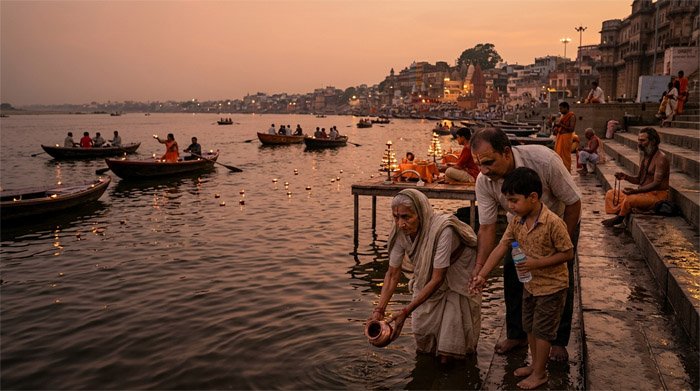
The entire riverfront of Kashi developed around the Ganga, with its ghats becoming places of bathing, worship, festivals, cremation, pilgrimage and everyday life.
In Kashi, therefore, Ganga Jal is not separate from the city.
The river and the city explain one another.
The ghats face the river.
The temples face the river.
Pilgrims come toward the river.
Morning begins beside the river.
Evening āratī rises before the river.
And generations have carried its water away with them.
Ganga Jal and Kashi
For Kashi, the relationship is especially intimate.
Kashi is not simply a city located beside the Ganga.
Its sacred identity has been shaped by the presence of the river.
The riverfront, the ghats and the ritual life of the city have developed together over centuries.
This gives Ganga Jal a special meaning when it is carried from Kashi.
The water becomes connected with a place of pilgrimage.
A small vessel can preserve the memory of a much larger journey:
- the journey to Kashi,
- the sight of the ghats,
- the sound of bells,
- the rising sun,
- the chanting of mantras,
- the fragrance of incense,
- and the presence of the river itself.
Ganga Jal can therefore function as a portable memory of pilgrimage.
The River That Connects Generations
There is another reason Ganga Jal feels so deeply connected with Indian households.
It is often passed from one generation to another.
A vessel of Ganga Jal may remain in a household for years.
It may be brought from a pilgrimage undertaken by a parent or grandparent.
It may be used during worship.
It may be preserved for a significant rite.
It may be offered with reverence during moments of transition.
In this way, Ganga Jal becomes part of family memory.
A child may not remember the journey when the water was collected.
But the vessel remains.
The practice remains.
The story remains.
And eventually the child learns why the water was treated differently from ordinary water.
This is how tradition survives—not only through books, but through objects, rituals, gestures and repeated remembrance.
Ganga Jal and Ancestral Remembrance
The Bhagīratha narrative gives Ganga Jal another profound dimension: pitṛ-smaraṇa, remembrance of ancestors.
The story of Bhagīratha is fundamentally connected with his determination to bring Gaṅgā for the benefit of his ancestors.
This means that the river becomes associated not only with personal purification but also with responsibility toward those who came before us.
The symbolism is powerful.
A person is not understood as an isolated individual.
He or she belongs to a lineage.
The present exists because of the past.
And therefore remembrance of ancestors becomes part of dharma.
Ganga, flowing across generations, becomes a natural symbol of this continuity.
The river flows forward, while memory flows backward.
Ganga Jal and Death
The relationship between Ganga and mortality is especially visible in Kashi.
At the ghats of Varanasi, the river has historically been associated with cremation, pilgrimage and rites surrounding death.
This creates one of the most profound symbolic associations of Ganga Jal:
the river becomes a witness to the entire human journey.
Birth. Initiation. Worship. Pilgrimage. Marriage. Old age. Death. Remembrance.
The same river that receives the morning bath also witnesses the final rites.
In this sense, Ganga represents continuity beyond individual moments.
Human beings come and go.
The river continues.
Why Ganga Jal Is Kept in Homes
There is a quiet symbolism in keeping Ganga Jal at home.
It creates a physical connection between the household and the sacred river.
A small vessel can serve as a reminder:
“This home remembers the sacred.”
It may be used during pūjā, certain saṃskāras, ceremonial purification, or other devotional practices according to family tradition.
The important point is not the size of the vessel.
It is the reverence attached to what it represents.
This is why traditionally preserved Ganga Jal is often treated respectfully rather than casually.
Ganga Jal and Daily Devotion
Ganga Jal also appears in everyday devotional life.
A few drops may be used while preparing for worship.
It may be offered during pūjā.
It may be sprinkled as part of a ritual.
It may be used while invoking sacred rivers.
It may accompany a saṅkalpa.
These practices differ between traditions, regions and families.
But beneath these differences lies a common principle:
water can become an instrument of remembrance.
The act of touching or offering Ganga Jal can bring the mind back toward the sacred.
The external water becomes connected with an internal movement of attention.
Ganga Is Not Merely a Symbol of Purity
There is a temptation to describe everything about Ganga through one word: purity.
But the symbolism is considerably richer.
Ganga represents:
- Descent — the sacred coming toward the human world.
- Purification — the movement from impurity toward renewal.
- Continuity — generations connected through one flowing river.
- Pilgrimage — the journey toward a sacred place.
- Memory — the preservation of experiences and traditions.
- Ancestry — remembrance of those who came before.
- Liberation — the religious aspiration associated with sacred tīrthas.
- Devotion — offering oneself before something regarded as greater than oneself.
That is why “sacred water” is only the beginning of the story.
The Ganga as Mother
In Indian devotional language, Gaṅgā is frequently addressed as Mātā — Mother.
This is not merely poetic decoration.
The metaphor expresses a relationship of dependence, nourishment and reverence.
A mother gives without asking for worship in return.
A river gives water. It nourishes fields. Supports settlements. Sustains ecosystems. Connects communities. And carries life downstream.
Thus the devotional image of Gaṅgā Mātā overlaps with the cultural experience of a river that has sustained generations.
A mother is not merely an object to be possessed. She is to be respected.
This is one reason reverence for Ganga also carries an ethical dimension.
Sacred Does Not Mean Disposable
There is an important lesson hidden inside the traditional reverence for Ganga.
If Ganga is regarded as sacred, then treating her carelessly creates a contradiction between ritual reverence and everyday conduct.
The cultural and religious significance of the river exists alongside the reality that the Ganga is also a major ecological and socioeconomic river system supporting enormous populations.
Therefore, reverence need not stop at ritual. It can become responsibility.
To respect Ganga is also to recognise that a sacred river is a living river.
The deeper symbolism of Ganga Jal should encourage care rather than consumption alone.
Ganga Jal Is Not Merely a Scientific Claim
There is another distinction worth preserving.
Traditional Hindu texts speak about the spiritual significance of Gaṅgā in theological and devotional language.
Those statements belong to the realm of śraddhā, śāstra and religious practice.
They should not automatically be transformed into modern scientific claims.
For example, when tradition describes Ganga as purifying, the word may carry a ritual, spiritual and theological meaning.
That is different from claiming that Ganga Jal is universally safe to drink, medically therapeutic, or scientifically incapable of contamination.
These are separate questions.
Respecting tradition does not require confusing devotional meaning with laboratory evidence.
In fact, keeping the distinction clear allows the sacred tradition to speak in its own language.
The Vessel of Ganga Jal
There is something beautiful about the traditional vessel containing Ganga Jal.
The vessel is small. The river is immense.
Yet the small vessel is treated with reverence because it represents the larger sacred reality from which it came.
This is a recurring principle in Hindu ritual culture.
A small mūrti represents a vast divine presence.
A single mantra invokes an immense spiritual tradition.
A small flame becomes the focus of āratī.
A handful of water becomes an offering.
And a small quantity of Ganga Jal can carry the memory of an entire sacred river.
The value lies not in quantity, but in meaning.
From the Himalayas to Kashi
The journey of Ganga itself can be understood as a sacred geography.
From the Himalayan region associated with Gaṅgā’s source, the river travels through the plains and becomes woven into countless landscapes and communities.
By the time it reaches Kashi, it has become inseparable from one of India’s most enduring pilgrimage cultures.
Here the river curves past the ghats. Boats cross its surface. Priests conduct rituals. Pilgrims bathe. Devotees perform offerings. Funeral rites take place. Evening lamps illuminate the river. And morning sunlight turns the water into a moving field of gold.
The river is simultaneously landscape, shrine, witness and memory.
Why People Carry Ganga Jal Home
A pilgrim who carries Ganga Jal home is carrying more than water.
They are carrying a relationship with a sacred place.
Perhaps they stood at Haridvāra. Perhaps they visited Prayāga. Perhaps they came to Kashi. Perhaps they collected it from a family pilgrimage generations ago.
When that water is later used in worship, the original journey is remembered again.
This is how sacred objects work within living traditions. They preserve memory. They make distant places present. They allow a pilgrimage to continue after the pilgrim has returned home.
Ganga Jal and the Meaning of Smaraṇa
One of the deepest ways to understand Ganga Jal is through the Sanskrit idea of smaraṇa — remembrance.
To remember is not merely to think about something casually.
In devotional life, remembrance can itself become a spiritual discipline.
Ganga Jal makes remembrance tangible. One sees it. Touches it. Offers it. Preserves it. And remembers Gaṅgā.
The river therefore becomes more than a geographical entity. She becomes something that can be carried in memory—and, symbolically, carried in a vessel.
Ganga Jal in Kashi’s Living Tradition
Kashi demonstrates how sacred traditions survive through repetition.
The river has remained part of daily life while the surrounding city has changed across centuries.
The ghats have been rebuilt and patronised by different rulers and communities. Temples and educational institutions have appeared around them. Pilgrimage practices have continued. Sanskrit learning and Vedic recitation remain part of the city’s cultural landscape.
This continuity is central to understanding Ganga Jal. It is not simply something inherited from a distant past. It is part of a living tradition that continues to be practiced.
More Than Sacred Water
So what is Ganga Jal?
It is water.
But within Hindu tradition, it can also represent:
- Gaṅgā Mātā.
- Purification.
- Pilgrimage.
- Ancestral remembrance.
- Divine descent.
- Continuity.
- Kashi.
- Devotion.
- Liberation.
- Memory.
And perhaps most importantly: a relationship between the human being and something regarded as sacred.
That relationship is why a small quantity of Ganga Jal can hold such enormous emotional and devotional significance.
The River Flows, Tradition Remains
Every generation sees the Ganga differently.
A pilgrim sees a tīrtha. A farmer sees water. A historian sees the river around which settlements and civilisations developed. A resident sees a part of everyday life. A devotee sees Gaṅgā Mātā. A family may see the water preserved by grandparents. A person visiting Kashi may see the river as the first and last image of the city.
These perspectives do not necessarily cancel one another. They reveal the many layers of a river that has remained central to Indian cultural memory for centuries.
The Ganga flows through geography. But Ganga also flows through memory.
A Final Reflection
Perhaps this is why Ganga Jal occupies such a distinctive place in the Indian home.
A vessel of Ganga Jal asks for very little. It does not demand elaborate explanation. It simply remains. Quietly.
A reminder of a river. A reminder of Kashi. A reminder of pilgrimage. A reminder of ancestors. A reminder of prayer. A reminder that traditions survive when they are not merely read about, but remembered, respected and practiced.
And perhaps the deepest symbolism of Ganga Jal is this:
The river does not stop flowing when the pilgrim leaves its banks. A few drops carried home allow the memory of that river to continue flowing into another place, another household, another generation.
From the Himalayas to Kashi. From scripture to ritual. From pilgrim to family. From one generation to the next. Ganga continues.
Selected Traditional & Scholarly References
- Ṛgveda 10.75.5 — Nadī-stuti / River Hymn: An early Vedic invocation explicitly naming Gaṅgā among the rivers.
- Skanda Purāṇa, Kāśī-khaṇḍa — Gaṅgā-māhātmya: A major Purāṇic source for traditions concerning the greatness and sanctity of Gaṅgā.
- Skanda Purāṇa, Kāśī-khaṇḍa — Contains the well-known invocation of the sacred rivers into ritual water.
- Padma Purāṇa, Uttara-khaṇḍa — Contains traditions concerning Gaṅgā, Viṣṇu and the Bhagīratha narrative.
- UNESCO — Historic Riverfront of Varanasi — Historical and cultural documentation concerning the Ganga, Kashi ghats, pilgrimage and continuing ritual traditions.
- Scholarly studies of the Ganga — Academic literature documenting the river’s cultural, religious, ecological and socioeconomic importance.
A Note on Traditional Claims: Descriptions of Gaṅgā as purifying, liberating or divinely descended belong to Hindu scriptural and devotional traditions. They are presented here in that religious context and should not be read as scientific or medical claims about the physical properties or safety of Ganga water.